Shelf life at the Overlook.
The Shining (1980), read one product, prop and pantry tin at a time.
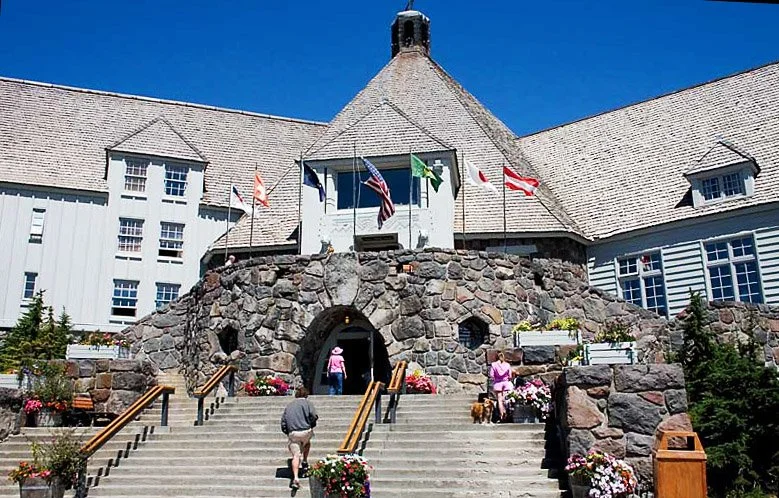
Welcome to Brands On Film
This is the first issue of Brands On Film. Every week we pick one movie and look at the commercial things inside the frame: the products, logos, mascots, packaging, sponsorship deals and quiet Easter eggs that sit in plain sight on the screen.
We're not here to roll our eyes at ad space. A soup can on a shelf is a prop someone picked out. A car is a costume for a character. A typeface tells you what year it is before any line of dialogue does. We look at these objects the way a set decorator does, and we take notes the way a brand marketer would.
The Shining is a good place to start because Stanley Kubrick crammed an R-rated horror film full of everyday American groceries. The Overlook Hotel looks like a palace, but its storeroom is a 1970s supermarket aisle. That clash of the grand and the ordinary is what this issue is about.
The obvious & the iconic
Four objects carry the most brand weight in The Shining. None of them was a documented paid deal. As far as published sources show, every one was a prop or a design choice, and that makes them more interesting, not less.
The yellow Volkswagen Beetle
The first thing we see is a tiny yellow Beetle working its way up a mountain road. IMCDB identifies it as a 1973 Volkswagen Sedan (Type 1). The road is Going-to-the-Sun Road in Montana's Glacier National Park, standing in for Colorado.
The Beetle is the right car for Jack Torrance. It's a cheap, round, cheerful car for a man who is broke and trying to look like a hopeful family guy. Shot from a helicopter, it looks like a toy, and that's the point. Before Jack ever reaches the hotel, the landscape has already made him small.
The color is a change from the book. Stephen King owned a red Beetle while he wrote the novel and gave the same car to Jack. Kubrick painted it yellow. Hold that thought for the Easter eggs section.
Jack's Adler typewriter
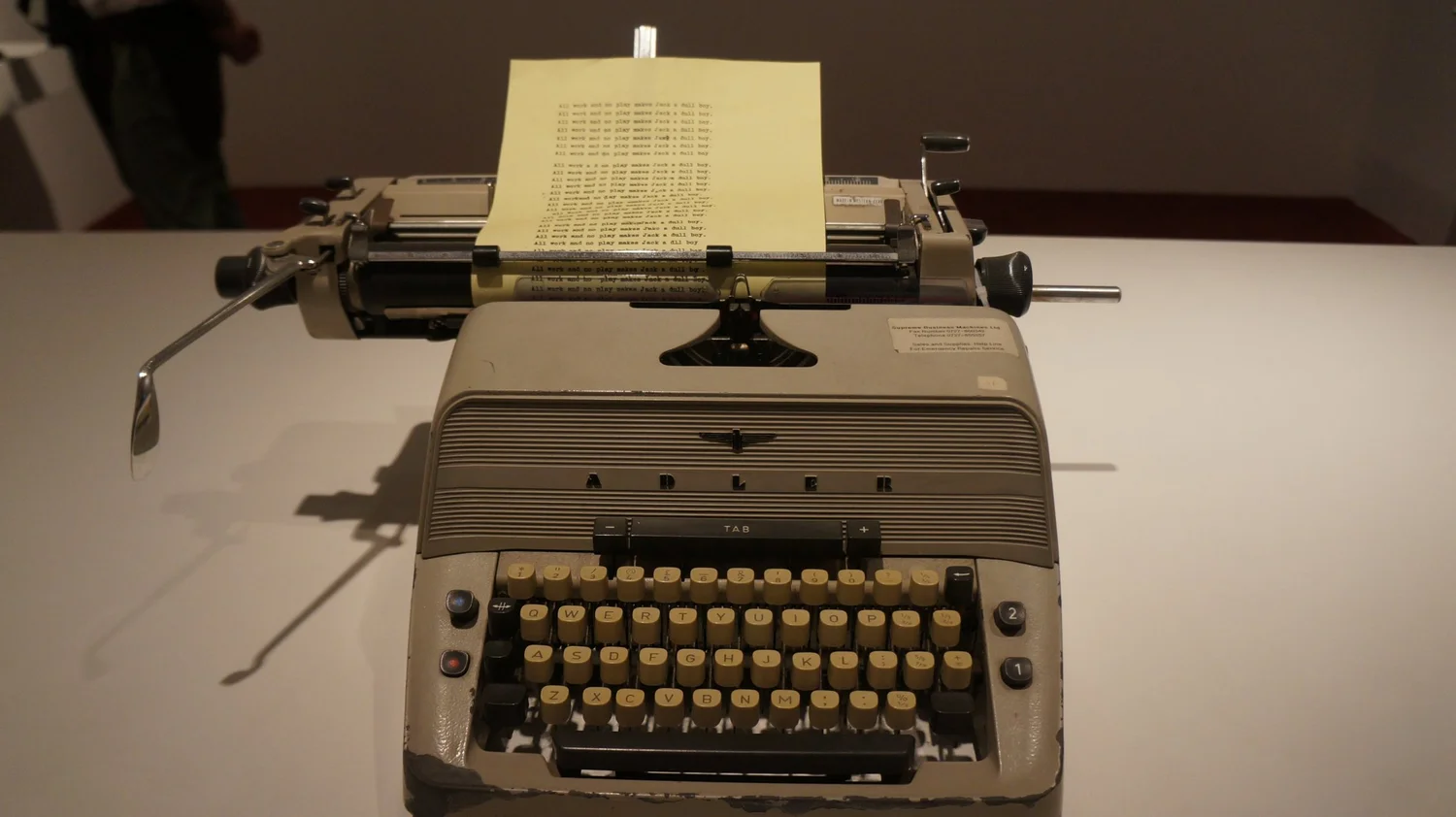
The Overlook's most famous prop comes from a German brand. Jack writes on an Adler, and collectors still argue about the exact model. The Typewriter Database and collectors on The RPF forum point to the Adler Universal 39, and others say it's a Tippa S. The machine is a clean, boxy slab of mid-century German industrial design. It's the tool of a serious writer, which is exactly what Jack wants to be.
Watch the color closely. Early on the typewriter is small and white, and later it's a bigger blue-gray machine (IMDb goofs; TypeRoom). TypeRoom also reports that the famous "All work and no play" pages were retyped in Italian, French, Spanish and German so they'd match each country's release. That's localization work done by hand, one key at a time.
The snowcat
King's novel had a yellow snowcat and a red VW. Kubrick swapped the colors and made the snowcat red. Enthusiasts have compared the film's machine to a Thiokol Spryte, and a Spryte still sits on Mount Hood near Timberline. The film never confirms the make, so treat that ID as likely, not certain.
The Spryte's maker has a good backstory. Thiokol started out in rocket-fuel chemicals before it built snowcats and ski lifts. It sold the snowcat business to John DeLorean in 1978. In a film that people link to the space race, the rescue vehicle comes from a rocket-chemical company. That's our observation, not Kubrick's stated plan, but it's a fun one.
The Hicks Hexagon carpet
The orange, red and brown hexagon carpet is one of the most famous floors in film. It's a David Hicks design called Hicks' Hexagon, made in the 1960s. Hicks's son Ashley has said that Kubrick copied a Hicks carpet and that David Hicks never worked on the film.
The carpet's afterlife is a licensing case study. Film and Furniture now sells officially licensed rugs and runners in the pattern, and Cole & Son sells it as wallpaper. A 1960s product line became famous because of a horror movie and is still selling for that reason 46 years later.
One more name on screen: the bat Wendy swings is a Louisville Slugger, according to Eyescream237's brand list, which spots it first on a lobby couch next to Jack.
The pantry, the shelf & the packaging
The Overlook's storeroom is a set made from real groceries. According to reporting on the documentary Shine On, the larder was a plain office at Elstree Studios in England. Kubrick filled it with working kitchen equipment, utensils, and real cans and boxes of food. That's why it looks bought, not built.

A 1979 supermarket, filed by aisle.
Fan researchers at Eyescream237 have logged 58 brands across the film. Reading that list as a shelf is like walking a 1979 American supermarket.
- Cereal aisleKellogg's, Frosted Flakes, Froot Loops, Cap'n Crunch
- Cookies & crackersNabisco, Oreo, Nutter Butter, Nilla, Ritz, graham crackers
- Cans & condimentsHeinz, Libby's, Bick's Pickles, Planters, Sysco food-service packs
- Drink mixes & coffeeTang, Kool-Aid, Country Time, Maxwell House, Sanka, General Foods' Café Vienna
- Under the sinkComet, Mr. Clean, Joy, Ivory
Calumet Baking Powder
The star of the shelf is a stack of red Calumet tins with a Native American chief logo. The brand dates back to 1889, when William Monroe Wright founded the Calumet Baking Powder Company in Chicago. General Foods bought it in 1929, and Kraft Heinz owns it today.
As packaging, the Calumet tin is a time capsule. Its bold red and its big, front-facing wordmark were designed to be read from across a store, and stacked in bulk, the tins suit a hotel kitchen built to feed a full house. The name means something too: a calumet is a ceremonial pipe, often called a peace pipe. That detail matters in the next section.
Tang, the drink that went to space
Tang is on Eyescream237's list too. General Foods put it on sale in 1959. Sales were weak until NASA chose it for John Glenn's 1962 flight and later missions, and after that General Foods sold it as the astronauts' breakfast drink. That puts a space-race brand in the same storeroom where Danny wanders in his Apollo 11 sweater.
A quick shelf note: Calumet, Tang and Café Vienna all came from General Foods. Whether that was on purpose or just what a big food-service supplier stocked in the late 1970s, the Overlook's pantry is something like a General Foods catalog.
Behind the Gold Room bar
In the Gold Room, Jack orders bourbon on the rocks from Lloyd, the bartender. The bottle he gets is widely identified as Jack Daniel's, with its square shoulders and black label. Eyescream237 also places Jack Daniel's on the back bar behind Lloyd and Hallorann. The same list logs Gordon's, Booth's, Smirnoff, Teacher's Highland Cream and Tio Pepe among the spirits on screen.
Picture that back bar as a wall of 1920s-style glamour stocked with mostly older heritage brands. Jack Daniel's dates back to 1875 by Eyescream237's count, so it feels right at home in a ballroom that's stuck in 1921.
Subliminal Easter eggs & auteur subtext
Kubrick rarely explained himself, so most of what follows is interpretation by critics and fans. Each one below is tagged Documented or Interpretation. What we can say for sure is that the brand details hold up under a freeze-frame, and that's why people keep reading meaning into them.
The crushed red Beetle
As Hallorann drives through the blizzard toward the Overlook, he passes a wreck: a red VW Beetle crushed under an 18-wheeler. Remember that King's Jack drove a red Beetle. Many fans see the wreck as Kubrick flattening the novel's version and saying "this one is mine." Others see it as a friendlier nod to readers that this story will go its own way. Either way, a car brand is doing the talking, which is about as pure a brand-as-storytelling moment as film has.
Room 217 becomes Room 237
This one is documented, and it's a hospitality brand decision. Timberline Lodge has a real Room 217, the room in the novel. Per the lodge's own FAQ, as quoted by TravelPulse, Kubrick was asked not to show 217 so future guests wouldn't be scared off, and he used a room number that doesn't exist.
The twist is that Room 217 ended up as Timberline's most requested room. A protective brand call turned into the hotel's best-known story. (For the record, King got the idea at the Stanley Hotel in Colorado, where he stayed in Room 217.)
Calumet, moved on purpose?
The best-known brand reading of The Shining comes from ABC reporter Bill Blakemore. In a 1987 Washington Post essay, summarized on Wikipedia, he argued the film is quietly about the killing of Native Americans. His evidence included the Calumet tins and the Native American artwork all over the hotel. In the documentary Room 237, Blakemore says the peace-pipe meaning of "calumet" is what first caught his eye (transcript).
Shot-by-shot analysts note that the Calumet tins aren't visible in one pantry setup but sit right behind Jack when Grady speaks to him through the door. Whether that was symbolism or just continuity, the cans were placed where the camera would see them. That much is a fact.
Apollo 11, and a secondhand sweater
Danny's hand-knit sweater shows a rocket labeled "APOLLO 11 USA." Room 237 gave a lot of time to the theory that this was Kubrick hinting he faked the 1969 Moon landing. The real story is gentler. According to BAMF Style, costume designer Milena Canonero found the worn sweater in a secondhand store while shopping with Danny Lloyd's family.
We like that answer more than the theory. It's a found object with real wear on it, which is exactly why it reads as a kid's actual sweater and not a costume.
The German typewriter and the Ritz box
Room 237 also floats a darker idea: that the German-made Adler, along with the number 42 that keeps showing up, points toward the Holocaust. Some writers read the Beetle the same way, since Volkswagen began as a Nazi-era project. On a lighter note, Eyescream237 wonders whether the Ritz crackers in the pantry wink at the Ritz hotels. These are readings, not facts, but they show how much meaning a brand name can carry for viewers who are paying attention.
Three clips to freeze-frame.
- The Shining: First 10 Minute MovieWarner Bros. UK HorrorPause the helicopter shots in the first few minutes and find the yellow Beetle. Notice how small the brand looks against the mountains. Then watch the cars and office details as Jack walks in for his interview.
- Dick Hallorann Teaches Danny The ShineClipZone: HorrorscapesThis is the kitchen talk where Blakemore first noticed a Calumet tin behind Hallorann's head. Scan the shelves behind Scatman Crothers whenever the camera holds still.
- The Shining (1980) | LloydThe Stanley Kubrick channelFreeze when Lloyd pours, and look over the backlit bottles for the square, black-labeled Jack Daniel's.
We couldn't find an official clip of Hallorann passing the crushed red Beetle. For that one, use your own copy of the film.

- Real products build real worlds.Kubrick stocked a fake hotel with real groceries, and 46 years later people still freeze-frame the shelves. A believable world earns attention that a logo pasted on top never will.
- The most valuable placements may be the ones nobody paid for.No source we found shows a paid deal in The Shining. Still, Calumet, Jack Daniel's and the Hicks Hexagon are linked to the film forever because they suit the story instead of interrupting it.
- Let fans and licensing carry the brand's afterlife.Timberline turned a protective request into its most requested room, and the Hicks pattern became licensed rugs and wallpaper. Plan for the second life of anything your brand puts on screen.
Building something that has to feel real on camera and in the room? That's the work I do. See how a project runs, or get a ballpark in two minutes.
Sources
- Eyescream237: List of Brands in The Shining
- IMCDB: 1973 Volkswagen Sedan 'Beetle' in The Shining
- Listverse: 10 Crazy Things Stanley Kubrick Did to Film The Shining
- Laemmle Vision: The Shining Introduction, Going-to-the-Sun Road
- Typewriter Database: 1965 Adler Universal 39
- Typewriter Database: 1978 Adler Tippa S
- The RPF: The Shining Typewriter
- TypeRoom: Stanley Kubrick and a typewriter affair to remember
- IMDb: The Shining goofs
- The Truth About Cars: Thiokol Spryte
- Curbside Classic: Thiokol snowcats
- Film and Furniture: The story behind Kubrick's carpet
- Film and Furniture: Hicks' Hexagon licensed carpet
- Film and Furniture: Hicks Hexagon wallpaper by Cole & Son
- AOL/IndieWire: Shine On, The Forgotten Shining Location
- Wikipedia: Calumet Baking Powder Company
- Wikipedia: Tang (drink mix)
- The Henry Ford: Tang "Chosen for the Gemini Astronauts" ad, 1966
- WhatCulture: 6 Famous Movie Drinks You Must Try
- TravelPulse: The hotel behind The Shining
- The Points Guy: The Stanley Hotel, Room 217
- The Shining (Wikipedia summary, via GradeSaver)
- Room 237 transcript
- Idyllopus Press: shot-by-shot analysis, the pantry
- BAMF Style: Danny's Apollo Sweater
- Medium: Secrets of The Shining